Theoretical models to guide undergraduate medical curriculum development: an integrative review | BMC Medical Education

Search outcome
The initial search yielded 1,672 items in both Chinese and English; after deduplication, 1,322 articles remained in both of these languages. Upon reviewing the article’s titles and abstracts, 115 studies were retained. Following a thorough review of the complete text and quality evaluation, 18 articles were ultimately included, comprising three studies in Chinese [6, 18, 19] and fifteen studies in English [20,21,22,23,24,25,26,27,28,29,30,31,32,33,34]. The detailed literature screening process is illustrated in Fig. 1.
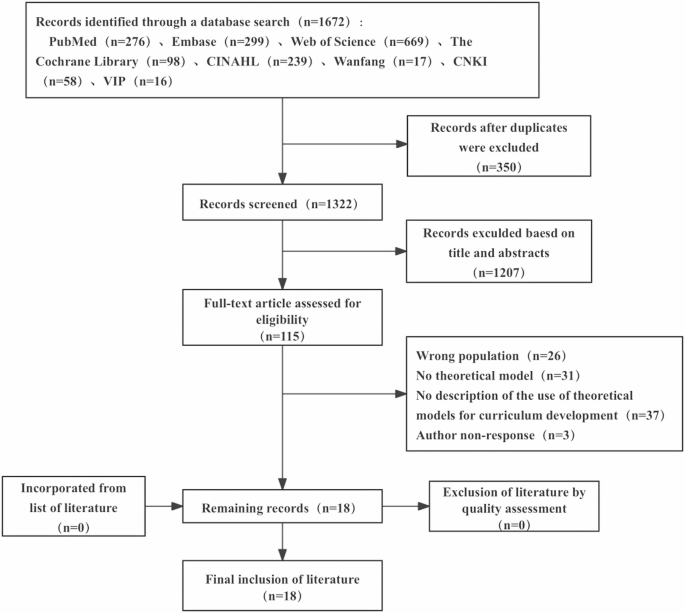
Flow diagram of the study selection
Results of the quality assessment
We did not exclude any articles based on quality assessment in this evaluation. The results of the detailed quality assessment are presented in Table 1.
Basic characteristics of the included studies
The final 18 pieces of literature included three qualitative studies [18, 21, 26], six quantitative studies [20, 25, 28, 29, 32, 34], and nine mixed-methods studies [6, 19, 22,23,24, 27, 30, 31, 33]. They were from China (n = 5), Iran (n = 3), India (n = 1), UAE (n = 1), USA (n = 2), Brazil (n = 1), Canada (n = 1), Ireland (n = 1), Australia (n = 2), and Pakistan (n = 1). The publication year of the included literature was between 2013 and 2024. Detailed information is shown in Table 2.
Theoretical models involved
Ten various theoretical models were employed to inform the development of eighteen curricula. Two curricula adhered to the Fink integrated curriculum design model (Fink Model) [6, 34], four followed the ADDIE model [20, 23, 28, 32], and five used Kern’s six-step method (Kern model) [22, 25, 30, 31, 33]. The remaining seven curricula were formulated using the DACUM model [18], the Taylor model [19], the Participatory Curriculum Development model (PCD model) [21], the seven-step model [29], Steketee’s four-dimensional framework [24], the Siragusa model [26], and the Talbot and Verrinder’s model [27].
All 10 theoretical models encompass the five stages of analysis, design, development, implementation, and assessment, but differ more or less in the specific steps. Among them, the DACUM model, the PCD model, and the Siragusa model are learner-competence-centered curriculum development models, while the ADDIE model, the Fink model, the Taylor model, the Kern model, the Seven-Steps model, Talbot and Verrinder’s model and Steketee’s four-dimensional framework are learning goal-centered curriculum development models.
Evaluation of the effectiveness of the implementation of the curriculum
Among the 18 articles in this review, 13 studies [6, 19, 20, 22,23,24,25, 27, 28, 30,31,32,33] implemented the curriculum and reported the efficacy of its implementation following the completion of curriculum creation based on the theoretical model. Information is shown in Table 3.
Evaluation methods
All 13 studies gathered quantitative data to evaluate the efficacy of curriculum delivery, and seven [6, 19, 22, 23, 31,32,33] of these also obtained qualitative data. Quantitative data were examined to determine the significance of differences in knowledge and skill scores among learners before and after the curriculum, the significance of differences in scores between learners and non-learners, and the assessment of curriculum satisfaction. Data were gathered by self-administered questionnaires, standardized scales, and statistics regarding visits to the learning platform. Qualitative data were collected on variables linked to curriculum creation, such as teaching content, duration and length of the course, teaching format, teaching tools, and instructors’ teaching level. Of the seven studies that reported qualitative data, two [6, 19] used semi-structured interviews, one [31] used focus group discussions, and four [22, 23, 32, 33] used open-ended questions in self-administered questionnaires to collect learners’ opinions. Furthermore, two of these studies gathered instructors’ experiences and recommendations regarding the teaching process [31, 33].
Deficiencies in curriculum implementation
Of the 18 articles included in this review, seven studies [6, 19, 22, 23, 31,32,33] identified factors perceived by learners as influencing their satisfaction with the delivered curriculum, including inadequate scheduling, limited offline practical activities, and unsuitable material selection.
Inadequate scheduling of curricula
Three studies [22, 31, 32] indicated that inappropriate curriculum scheduling or duration planning adversely affects learners’ experience of learning completeness, obstructing their comprehensive grasp of knowledge and abilities. In the study by Sampangiramaiah et al. [32], participants indicated that the two-week duration of the elective course was inadequate for thorough and systematic learning. Hashmi et al. [31] indicated in their study that learners found the timing of the curriculum inappropriate, making it difficult to keep up with the material at their current stage. McDonald et al. [22] observed in their study that learners saw a disorganized curriculum schedule as a factor leading to inefficient ward training sessions.
Insufficient offline practical activities
Four [6, 19, 22, 23] studies reported that a deficiency of offline practical activities hinders learners from converting theoretical knowledge into practical skills. In Yu’s study [6], participants reported a lack of opportunities to interact with real patients, which hindered the development of their narrative nursing skills. This conclusion was supported by the research of Tobase et al. [23], in which learners indicated a preference for augmented face-to-face sessions, especially more frequent in-person simulation training, to enhance their proficiency in fundamental life support skills. Furthermore, both Song [19] and McDonald et al. [22] reported learners’ observations regarding the deficiency of offline practical activities, advocating for the incorporation of additional theme-based discussions, narrative-sharing sessions, and scenario simulations to augment practical learning experiences.
Inappropriate textbook selection
Three studies [6, 19, 31] indicated that improper textbook selection may adversely affect learners’ motivation and induce unwarranted stress. Both Yu [6] and Song [19] reported learners’ comments concerning the absence of standardized curriculum materials, which impeded their capacity to effectively review and consolidate knowledge. Moreover, Hashmi et al.‘s study [31] indicated that most learners favored succinct and straightforward handouts, deeming research publications less beneficial for their current academic level and somewhat taxing to understand.
Key steps in the development of undergraduate medical curriculum
Based on the ten theoretical models included and by analyzing the key steps and components involved, this study integrates a comprehensive framework to guide the development of undergraduate medical curricula, as shown in Fig. 2.

Key steps in undergraduate medical curriculum development
Step 1: curriculum situational analysis
Of these 10 theoretical models, all except the DACUM model of curriculum development identify situational analysis as the initial phase, with learner needs analysis being the most critical component. Among the nine models, the Fink model presents the most thorough situational analysis, asserting that situational factors must encompass the specific environment for curriculum implementation, external expectations (society, school, teachers), the curriculum’s nature, learner characteristics, teacher attributes, and specific pedagogical challenges, emphasizing that these situational factors should be cohesively integrated to form a coherent whole [6].
Step 2: curriculum objective definition
Curriculum objectives are the explicit aims and intentions to be attained by the curriculum, encompassing knowledge, skills, affective attitudes, and values. The Fink, Kern, Taylor, Seven-Step, ADDIE, Siragusa, and Talbot and Verinder model all emphasize the necessity of establishing curriculum objectives. The Fink model categorizes significant learning objectives into six dimensions: foundational knowledge, application, integration, human dimension, caring, and learning to learn; and the Taylor model classifies curriculum objectives into three dimensions: knowledge, skills, and attitudes.
Step 3: curriculum content design
A comprehensive curriculum design encompasses the selection and development of curriculum content and modules, the identification of teaching methods and strategies, the innovation of instructional techniques and tools, and the preparation of educational resources (textbooks, reference materials, and multimedia resources). Each of the ten theoretical models considered in this review incorporates curriculum design elements. The Fink model is the most noteworthy in terms of standardization as it delineates the stages of curriculum design: selecting effective instructional activities, constructing a curriculum framework, choosing or developing instructional strategies, and ultimately integrating the curriculum framework with instructional strategies to facilitate curriculum delivery. Furthermore, the concluding phase of the model underscores the importance of addressing potential challenges that may occur throughout curriculum implementation. In terms of the comprehensiveness of curriculum content design, the ADDIE model is one of the most prominent of the ten theoretical models. It considers not only the development of content, teaching activities, teaching methods, and syllabi at the design stage but also the design and preparation of teaching resources such as textbooks and handouts at the development stage.
Step 4: curriculum implementation and evaluation
After the completion of curriculum development, the stage of curriculum implementation and evaluation is entered, and curriculum evaluation is the process of systematically evaluating the effectiveness of curriculum implementation. All ten theoretical models included in this study mention the construction of a curriculum implementation and evaluation system. In terms of curriculum implementation, the Siragusa model states that attention should be paid to learners’ motivation, engagement, interaction, and communication with teachers, while the other models do not provide further details. Concerning the development of a curriculum evaluation system, all ten models incorporate both formative and summative evaluations, with formative evaluation taking place during curriculum execution and summative evaluation occurring at the curriculum’s conclusion. The Fink model offers an elaboration wherein assessment encompasses both accreditation and pedagogical evaluations. Accreditation assessment aligns with summative assessment, whereas pedagogical evaluation aligns with formative assessment, encompassing prospective assessment, student self-assessment, and FIDeLity feedback (frequent, immediate, discriminating, and caring feedback).
link